
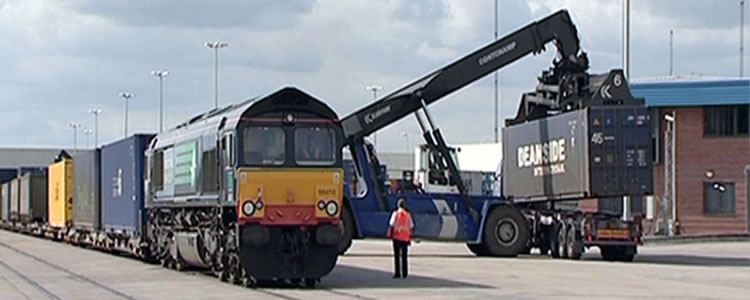
The transfer of freight from road to rail is supported by the public, industry and Government alike.
But in order to achieve its own 80% growth target for railfreight over the next decade, the Government recognises that new railfreight interchanges will be required, where freight can be transferred between trains, trucks and warehouses.
Private companies are now looking to commit major investment to develop these new "freight villages", to satisfy industry requirements and support a raft of Government policy objectives, for transport, the environment and regional development.
Yet the current planning process is frustrating these efforts and the opportunities which could be created.
RIIG (Railfreight Interchange Investment Group) has been created to address these issues, and so support Government, industry and environmental objectives for increasing use of railfreight.
What is a railfreight interchange?
The Strategic Rail Authority's recent Freight Strategy states
"to support development of rail in the general freight market, a small number of large new interchanges will be required with both intermodal capacity and rail connected warehousing.
To be efficient these must be large enough to accommodate longer trains with modern wagons, rapid means of cargo transfer, handling and storage. They may also provide activities such as warehousing, stockholding or processing, all of which may be regarded as adding value to the process of modal transfer.
Road access must be good and the operation compatible with neighbouring land uses."
|
 |
 |
An intermodal facility, to enable transfer of containers, swap bodies and piggyback trailers between road and rail vehicles and nearby industrial / distribution users
|
 |
 |
Rail-linked industrial / distribution buildings, to enable direct transfer of freight between conventional rail wagons and production or storage areas
|
|